
In the dynamic and competitive landscape of the internet, a visually appealing website is just the beginning. Beyond aesthetics, the success of a website often hinges on its ability to convert visitors into customers, subscribers, or engaged users.
One of the key elements influencing conversion rates is the strategic placement of Call-to-Action (CTA) buttons. In this guide, we will delve into the art and science of designing for conversions, focusing on proven strategies for optimal CTA placement.
Understanding the Role of CTAs
Before diving into placement strategies, it’s crucial to understand the significance of CTAs in the user journey. A Call-to-Action serves as a prompt, guiding visitors toward a specific action, whether it’s making a purchase, signing up for a newsletter, or downloading a resource. Effective CTA placement is about seamlessly integrating these prompts into the user experience, making them compelling and accessible.
The Science Behind Effective CTA Placement
Above the Fold: Grab Attention Instantly
The area visible without scrolling, known as “above the fold,” is prime real estate for CTAs. Placing a compelling CTA here ensures that visitors encounter it immediately upon landing on your site. Use concise and action-oriented language to communicate the value proposition, enticing users to take the desired action without having to explore further.
Eye Tracking Studies: Follow Natural Reading Patterns
Research shows that users tend to follow an “F” or “Z” pattern when scanning web pages. Strategically placing CTAs along these patterns, especially at the endpoints, capitalises on natural eye movement. This ensures that even casual readers are likely to come across your CTA, increasing the chances of conversion.
Content Relevance: Align CTAs with Page Content
Every web page serves a specific purpose and addresses certain user needs. Align your CTAs with the content on each page to ensure relevance. For instance, if a page discusses the features of a product, the CTA could prompt users to explore pricing or make a purchase.
Mobile Responsiveness: Capturing On-the-Go Conversions
With the increasing prevalence of mobile devices, optimising CTAs for smaller screens is paramount. Mobile users have distinct browsing behaviours, often involving quick interactions. Ensure that your CTAs are not only responsive but also strategically placed within thumb reach, facilitating easy navigation and interaction on mobile devices.
A/B Testing: Iterative Refinement for Maximum Impact
The digital landscape is ever-evolving, and what works today may not be as effective tomorrow. A/B testing is a powerful tool for optimising CTA placement. Experiment with variations in position, colour, size, and text to identify the most effective combination. Regularly testing and refining your approach based on user behaviour insights can significantly enhance conversion rates over time.
Additional Considerations for Effective CTA Placement
Usability and Accessibility: Ensuring a Seamless Experience
Beyond strategic placement, consider the usability and accessibility of your CTAs. Ensure that they are easily clickable, with a design that stands out but doesn’t overwhelm. High-contrast colours and clear button shapes contribute to a user-friendly experience, making it easier for visitors to navigate and engage with your CTAs.
Personalisation: Tailoring CTAs to User Segments
Personalised CTAs based on user behaviour and demographics can significantly impact conversion rates. Leverage data analytics to understand user preferences and tailor CTAs accordingly. For instance, a returning customer might see a CTA emphasising loyalty benefits, while a new visitor sees an invitation to explore featured products.
Strategic Timing: Introducing CTAs in the User Journey
Consider the timing of your CTAs within the user journey. Introduce softer CTAs for first-time visitors, such as inviting them to subscribe to a newsletter. As users engage more deeply with your content, gradually introduce stronger CTAs that prompt them to make a purchase or request more information.
Social Proof Integration: Boosting Credibility and Trust
Incorporate social proof elements strategically around your CTAs. Testimonials, reviews, or user ratings can build trust and credibility, making visitors more likely to respond to your CTAs. Place these elements close to the CTA to reinforce the value proposition and reassure users about the positive experiences of others.
Analytics and Iterative Improvement: Fine-Tuning for Success
Utilise web analytics tools to monitor the performance of your CTAs. Track click-through rates, conversion rates, and user interactions. Analysing this data provides valuable insights into what is working and what needs improvement. Use these insights for iterative refinement, continuously enhancing your CTA strategy for optimal results.
Contextual Language: Crafting Compelling CTA Copy
The language used in your CTAs plays a crucial role in user engagement. Craft concise and action-oriented copy that resonates with your target audience. Experiment with language that creates a sense of urgency or exclusivity, prompting users to take immediate action. A/B test different copy variations to identify the most effective messaging.
Integration with Visual Hierarchy: Directing User Attention
Integrate your CTAs seamlessly into the visual hierarchy of your website. Utilise design elements such as colour, size, and placement to direct user attention towards the CTAs. Ensure that they stand out without being intrusive, maintaining a balance that enhances the overall user experience.
Case Study: Modern Antiquarian
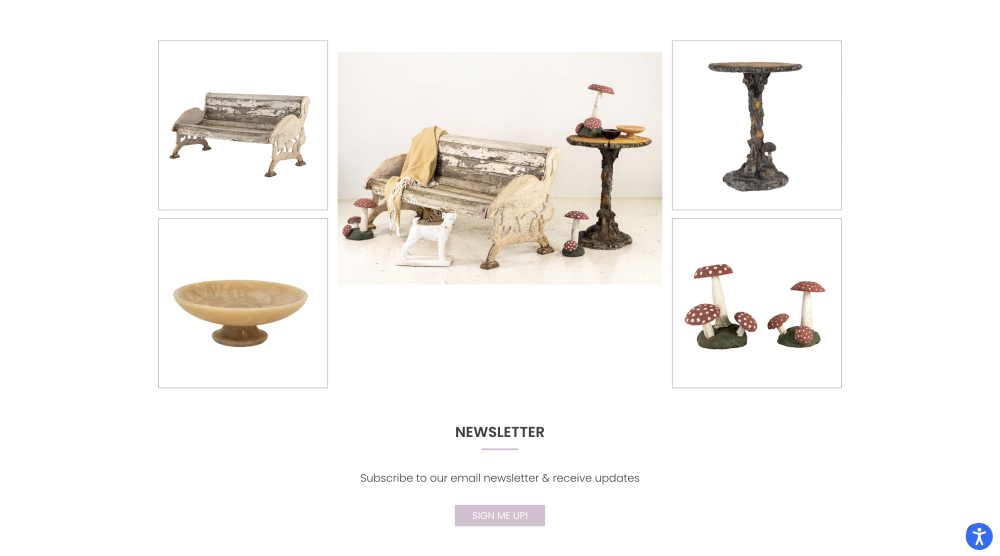
Newsletter Subscription
As visitors scroll through the homepage of this antique garden furniture business, captivated by the photos of meticulously preserved antiques, the journey is punctuated by an invitation. Just below the mesmerising images, a CTA awaits.
Subscribe to our email newsletter & receive updates
This placement is not arbitrary; it’s a conscious decision to intertwine the allure of the antiques with the promise of a continuous journey. The CTA leverages the visual appeal of the antiques, prompting visitors to become part of a community.
Incorporating these additional considerations into your CTA placement strategy can elevate the effectiveness of your website in converting visitors into valuable actions. A holistic approach, combining strategic placement with usability, personalisation, and analytics, ensures a well-rounded strategy that adapts to the evolving needs and behaviours of your audience. With these UK spelling guidelines, your web design will resonate with a wider audience in the British market.
