
There was a time when selling bespoke, handcrafted products online felt like a compromise. The dominant e-commerce platforms of the early web were built for volume retail — uniform products, standard sizes, fixed prices.
They were not designed for the world of artisan makers, where every piece might be unique, pricing depends on specification, and the relationship between maker and customer is as important as the transaction itself. That has changed significantly, and WordPress — combined with the right WooCommerce setup and theme — has been at the centre of that change.
Why WordPress Is the Right Foundation for Artisan Brands
WordPress powers over 40% of all websites on the internet, but its real strength for premium and artisan brands lies not in its ubiquity but in its flexibility. Unlike closed e-commerce platforms that impose their structure and aesthetic on every store, WordPress allows complete design freedom. A bespoke garden products company can build a site that looks nothing like a typical online shop — no grid of product tiles, no “add to cart” buttons cluttering the hero image — while still delivering a fully functional purchasing or enquiry experience behind the scenes.
The WooCommerce plugin, which turns a WordPress site into a shop, is equally flexible. It handles everything from straightforward product purchases to complex quote-based enquiries, deposits for bespoke orders, and multi-step customisation forms. For artisan businesses where customers might want to specify materials, dimensions or finishes before placing an order, this flexibility is invaluable.
Theme and Design Choices That Work for Premium Products
The default WooCommerce experience is functional but generic. The real work for artisan brands is in the theme and design layer — establishing a visual identity that communicates the premium nature of the product before the visitor has engaged with a single product listing.
Full-width photography themes have become the preferred choice for luxury and artisan businesses on WordPress. These themes treat the homepage as a visual editorial experience — leading with beautiful, atmospheric photography, using generous whitespace, and introducing navigation and product categories in a way that feels considered rather than commercial. Block editor themes (using the WordPress Gutenberg editor) have made this kind of editorial control accessible to non-developers, allowing brands to craft beautiful pages without writing code.
Advanced Custom Fields (ACF) and custom post types allow artisan brands to build product pages that go beyond the standard WooCommerce template — incorporating provenance information, maker’s notes, care instructions and detailed specification tables in a way that feels integral to the product presentation rather than bolted on.
Enquiry-Based Commerce
Not every artisan product can be bought with a single click. Bespoke items — made to order, hand-finished, crafted to specific dimensions — typically require a conversation before a purchase is made. WordPress handles this nuance particularly well. Gravity Forms or WPForms can create sophisticated multi-step enquiry processes that feel like a natural part of the customer journey rather than a barrier to it. A visitor interested in a bespoke garden piece can specify their requirements, receive a quote and begin a relationship with the maker — all through the website, without the experience feeling like filling in a form.
For makers who exhibit at trade shows, Chelsea Flower Show or similar events, WordPress also makes it easy to create landing pages for specific events or limited collections without overhauling the entire site — a practical advantage that closed platforms struggle to replicate.
Page Speed and Image Optimisation
Artisan and garden product websites are typically very image-heavy. Full-width photography, detail shots, lifestyle images and project galleries all add up to significant page weight. On WordPress, a well-configured caching plugin (WP Rocket, W3 Total Cache), a CDN (Cloudflare being the most widely used), and image optimisation via a plugin such as Imagify or ShortPixel can dramatically reduce load times without compromising visual quality. For mobile users — increasingly the first point of contact for many browsers — page speed directly affects both user experience and search ranking.
Case Study: Heritage Handmade Garden Collections
A strong example of WordPress delivering beautifully for a premium artisan business is Heritage Handmade Garden Collections, a specialist maker of fine garden pieces including bespoke garden ornaments, planters and handcrafted stonework.
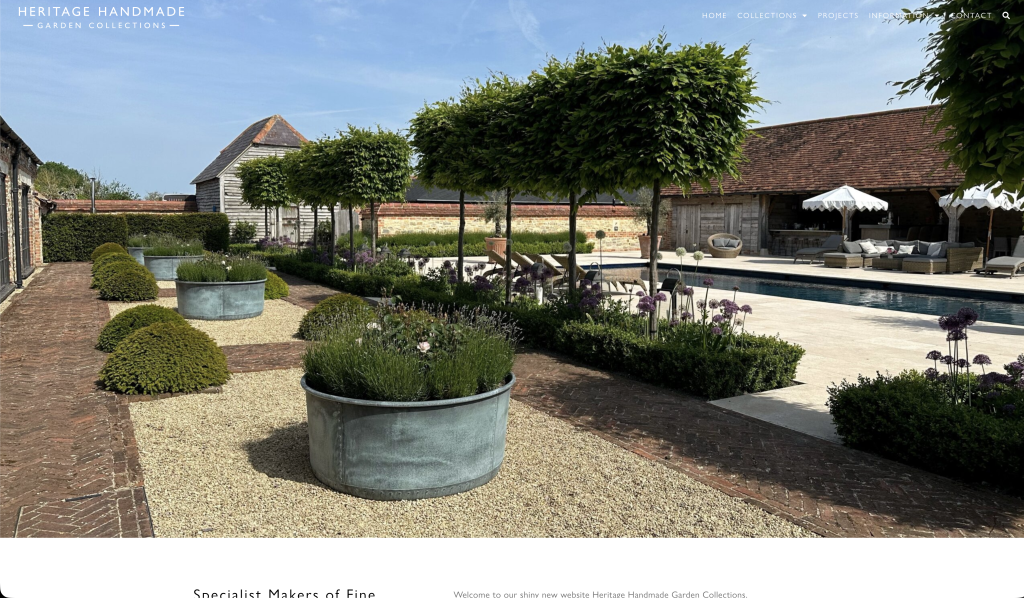
The site leads with the kind of full-screen, atmospheric garden photography that would not look out of place in a high-end interiors magazine. The navigation is minimal, the branding restrained and consistent. Scrolling through the site, the focus remains entirely on the craftsmanship and the setting — not on the mechanics of a conventional online shop. The product and enquiry experience is handled gracefully in the background, but the dominant impression is of a brand with a clear aesthetic identity and the design confidence to let its work speak.
This kind of presentation — premium, editorial, uncluttered — is exactly what WordPress enables when it is well-configured and thoughtfully designed. For a business selling bespoke garden ornaments and handmade pieces to a discerning audience, the digital experience needs to match the quality of the physical product. Heritage Handmade Garden Collections achieves that alignment convincingly.
Security and Maintenance
One consideration often overlooked by artisan brands setting up on WordPress is the ongoing maintenance requirement. WordPress’s open-source nature makes it the most targeted platform for security vulnerabilities, and regular updates to core, themes and plugins are essential. Managed WordPress hosting (through providers like Kinsta, WP Engine or Flywheel) removes much of this burden, providing automatic updates, daily backups and enhanced security — allowing small artisan businesses to focus on their craft rather than their server administration.
Conclusion
WordPress has grown into a genuinely powerful platform for artisan and premium product brands — one that offers the design flexibility to create experiences that feel true to the product, the e-commerce functionality to handle complex bespoke orders, and the SEO foundation to compete effectively in organic search. Heritage Handmade Garden Collections demonstrates what is possible when WordPress is used with real design ambition: a site that is as carefully crafted as the bespoke garden ornaments it showcases. For artisan makers considering their digital options, the platform remains one of the most capable and adaptable foundations available.
